How to Choose X2 RC Capacitors for EMI Suppression in Power Circuits

Advantages of Polypropylene Film Capacitors in High-Frequency Applications
Polypropylene film capacitors are widely used in high-frequency power electronics including SMPS power supplies, IGBT switching circuits, DC-link snubber networks, EMI suppression filters, and resonant converters. Their electrical characteristics directly impact switching efficiency, thermal stability, and long-term reliability.
Compared with polyester (MKT) capacitors, polypropylene (MKP) film capacitors offer lower dielectric loss, higher ripple current capability, and superior frequency stability, making them ideal for pulse-intensive and high-speed switching applications.
Why Polypropylene (MKP) Is Ideal for High-Frequency Circuits
Ultra-Low Dielectric Loss
Polypropylene dielectric material features a very low dissipation factor (tan δ), reducing AC power loss under high-frequency operation and minimizing internal temperature rise.
Low ESR and High Ripple Current Capability
Low Equivalent Series Resistance (ESR) and low parasitic inductance (ESL) enable MKP capacitors to withstand high ripple current and fast switching transitions without excessive heat generation.
Stable Capacitance Across Temperature and Frequency
Polypropylene maintains stable capacitance over a wide temperature and frequency range, ensuring reliable performance in filtering, timing, and industrial control systems.
JB Film Capacitor Series Overview
Axial MKT & MKP Capacitors

Axial lead film capacitors are suitable for through-hole PCB assemblies and industrial electronics.
IGBT Snubber Capacitors

Designed for high dv/dt environments, these polypropylene capacitors are ideal for inverters, motor drives, and DC-link snubber circuits.
Polyester (MKT) Film Capacitors

Cost-effective and compact, polyester capacitors are suitable for general signal filtering and consumer electronics.
Polypropylene (MKP) Film Capacitors

MKP capacitors deliver ultra-low dielectric loss, high ripple current capability, and self-healing reliability for demanding high-frequency applications.
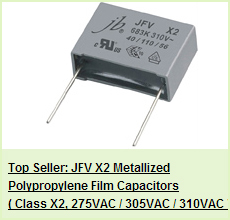
Safety Interference Suppression Capacitors (X2 / Y2)

Safety capacitors are required for AC mains EMI suppression and compliance with international safety standards.
Polypropylene vs Polyester Comparison
| Parameter | Polyester (MKT) | Polypropylene (MKP) |
|---|---|---|
| Dissipation Factor | Moderate | Very Low |
| High Frequency Performance | Limited | Excellent |
| Ripple Current Capability | Moderate | High |
| Thermal Stability | Good | Superior |
| Cost | Lower | Higher |
Conclusion
For high-frequency switching and pulse-intensive power electronics, polypropylene film capacitors provide optimal efficiency, stability, and reliability.
Need assistance selecting the right polypropylene or polyester film capacitor for your high-frequency design? Our engineering team provides datasheets, technical guidance, and customized solutions.
Design Considerations for Aluminum Electrolytic Capacitors in SMPS and Industrial Systems

Aluminum Electrolytic & Motor Capacitors for SMPS and Industrial Applications
jb Capacitors provides high-reliability aluminum electrolytic capacitors and motor capacitor solutions engineered for SMPS, DC link filtering, industrial automation, HVAC systems, and power electronics applications.
Snap-in Aluminum Electrolytic Capacitors
jb snap-in aluminum electrolytic capacitors are designed for high ripple current SMPS, DC link capacitors, motor drives, renewable energy systems, and industrial power supply modules. Available lifetime ratings range from 1000H to 5000H at 85°C and 105°C, ensuring long-term stability under demanding electrical stress conditions.
Radial Aluminum Electrolytic Capacitors
jb radial aluminum electrolytic capacitors provide low ESR performance and extended lifetime up to 10000 hours at 105°C. Widely used in LED drivers, industrial control boards, consumer power adapters, and general SMPS filtering circuits.
SMD Aluminum Electrolytic Capacitors
Surface mount aluminum electrolytic capacitors from jb are optimized for compact PCB layouts and automated SMT assembly. Ideal for embedded systems, high-density SMPS designs, telecommunications equipment, and industrial electronics.
Motor Running & Motor Starting Capacitors
jb motor capacitor solutions include CBB60, CBB61, and CBB65 film motor running capacitors, as well as high-capacitance motor starting capacitors. Designed for HVAC systems, compressors, pumps, fans, and industrial motor applications requiring stable torque and long operational lifespan.
Application Guide: Selecting the Right Capacitor by System Type
Selecting the appropriate aluminum electrolytic capacitor depends on operating voltage, ripple current, ambient temperature, and lifetime expectations. Below is a structured selection reference for common SMPS and industrial applications.
AC-DC SMPS Primary Side (Bulk Capacitor)
In front-end rectification stages, aluminum electrolytic capacitors function as bulk energy storage components following the bridge rectifier. Key design considerations include high ripple current capability, at least 20% voltage derating margin, and stable performance at 105°C operating temperature. Snap-in capacitors are typically preferred in higher power SMPS designs.
DC Link Capacitors for Motor Drives and Inverters
In industrial motor drives and inverter systems, DC link capacitors must withstand continuous RMS ripple current and thermal stress. Low ESR, high ripple current rating, and mechanical robustness are critical selection parameters. Snap-in or screw terminal aluminum electrolytic capacitors are commonly implemented in these applications.
Secondary Side Output Filtering in SMPS
On the secondary side of switching power supplies, aluminum electrolytic capacitors smooth output ripple and support transient load response. Low ESR radial or SMD aluminum electrolytic capacitors are widely used depending on PCB layout constraints and automated assembly requirements.
LED Drivers and Industrial Control Boards
For LED drivers and embedded industrial electronics, long lifetime consistency and thermal endurance are essential. Long-life 105°C rated radial aluminum electrolytic capacitors are commonly selected with conservative voltage derating to ensure extended service life.
For full electrical specifications, lifetime ratings, and available series options, visit:
Explore Aluminum Electrolytic Capacitor Series →
How Sulfur in the Air Causes Chip Resistor Drift
Engineering Reliability Issue: Sulfur exposure in industrial and automotive environments leads to long-term resistor drift, impacting industrial resistor reliability and circuit stability.

Problem
Industrial control boards, HVAC systems, and automotive ECUs often show gradual signal offset after months of operation. Design ratings appear correct, yet resistance drift occurs due to environmental sulfur exposure.
Cause
Thick film chip resistors use RuO₂ resistive layers and silver-containing terminations. Sulfur reacts with silver, forming silver sulfide, increasing termination resistance and altering current distribution.
Risk
- Voltage divider accuracy loss
- Sensor signal offset
- ADC reference instability
- Control loop timing drift
- Automotive ECU reliability issues
Upgrade Path
| Series | Primary Reliability Focus | Recommended Use Area | Upgrade Decision Trigger |
|---|---|---|---|
| jb JZC Thick Film Chip Resistor | Standard stability | General circuits | No sulfur exposure |
| jb JZP High Power Thick Chip Resistor | Thermal margin | Hot PCB zones | Temperature derating concern |
| jb JZQ Automotive Thick Chip Resistor | Anti sulfur + AEC Q200 | Industrial & automotive harsh air | Sulfur + pollution risk |
Evaluate the full chip resistor range here Chip Resistor Series
No PCB Redesign
All series share standard SMD footprints enabling drop-in resistor replacement without layout change.
Submit Design Parameters for Reliability Evaluation
Provide package size, resistance value, PCB temperature, and application environment.
Why Zinc Oxide MOVs Are Preferred for Surge Protection


Modern power and industrial electronic designs rely on metal oxide varistors (MOVs) to protect circuits from transient voltage surges caused by lightning, switching events, or unstable power conditions. For engineers and sourcing teams evaluating MOV replacement or alternative options, understanding MOV structure, voltage classes, and application suitability is essential.
This article provides a technical overview of JVX Metal Oxide Varistors, focusing on structure, operating characteristics, typical applications, and class-level alternative selection guidance.
Metal Oxide Varistor Structure Overview

A metal oxide varistor is constructed using zinc oxide (ZnO) ceramic grains sandwiched between two metal electrodes, resulting in a highly nonlinear voltage-current characteristic.
- High impedance under normal operating voltage
- Rapid impedance drop when surge voltage exceeds threshold
- Surge energy absorption and voltage clamping
JVX Metal Oxide Varistor Key Characteristics
- Operating temperature: -40°C to +105°C
- Disc diameters: 5D, 7D, 10D, 14D, 20D
- Varistor voltage range: 18V to 1800V
- Compliance: RoHS, REACH
Typical Surge Protection Applications
- Industrial power supplies
- AC-DC converters and SMPS designs
- Home appliance control boards
- Motor drives and inverter systems
- Power protection modules
Class-Level MOV Alternative Selection Guidance
JVX Metal Oxide Varistors are designed to align with common industry MOV voltage and disc-size classes. Comparisons are provided at the class level only and do not constitute direct part-number cross references.
| Varistor Voltage (V₁mA) | Disc Diameter | JVX Series | Comparable MOV Class | Typical Brands Referenced |
|---|---|---|---|---|
| 470V (471K) | 7mm | JVX07D471K | V07 class | Vishay, TDK, Bourns |
| 470V (471K) | 10mm | JVX10D471K | V10 class | Vishay, TDK, Bourns |
| 470V (471K) | 14mm | JVX14D471K | V14 class | Vishay, TDK, Bourns |
| 470V (471K) | 20mm | JVX20D471K | V20 class | Vishay, TDK, Bourns |
Watch: How Metal Oxide Varistors Protect Circuits
Explore JVX Metal Oxide Varistors
Explore the JVX MOV series and contact jb for selection and application support.
Looking for Jantzen or Mundorf Alternatives? JMX & JLX Audio Capacitors with Fast Lead Time

Looking for Jantzen or Mundorf Alternatives? JMX & JLX Audio Capacitors with Fast Lead Time
When engineers search for a Jantzen alternative capacitor or a Mundorf equivalent capacitor, the concern is rarely just brand comparison. What truly matters is whether the audio capacitor replacement can deliver stable electrical performance, predictable sound characteristics, and a supply lead time that supports real project schedules.
JMX and JLX audio capacitors from jb Capacitors are developed to address these evaluation criteria, offering high-end audio performance with clear sourcing advantages. For teams evaluating fast lead time capacitors, the goal is to reduce uncertainty during design-in and RFQ stages.
Product Overview
JMX – High-Voltage Audio Capacitor for Signal Integrity
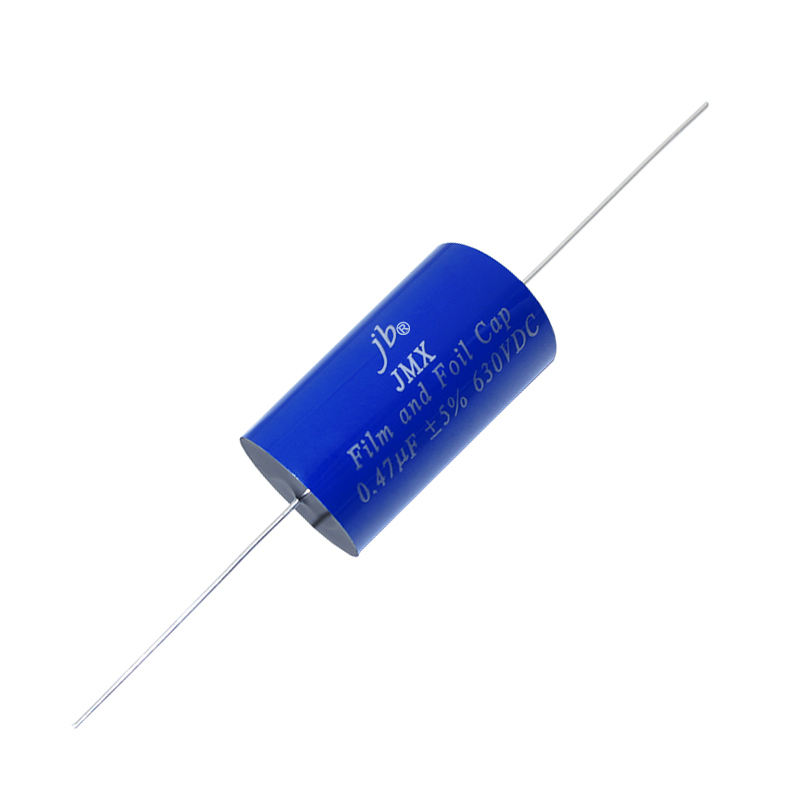
The JMX Music Aluminum Foil and Film Metallized Polypropylene Capacitors (Axial) are designed for audio circuits where signal purity and stability are critical. From a design perspective, engineers often consider JMX when evaluating audio capacitor replacements for high-voltage signal paths.
Why JMX is frequently evaluated
- Very low dissipation factor (≤0.0002 @ 1kHz)
- Very low ESR and inductance for clean signal transmission
- Rated voltage up to 630VDC, suitable for high-voltage audio designs
- Commonly used in amplifiers, speakers, and crossover networks
JLX – High-End Audio Capacitor for Tweeter & Mid-Range Applications
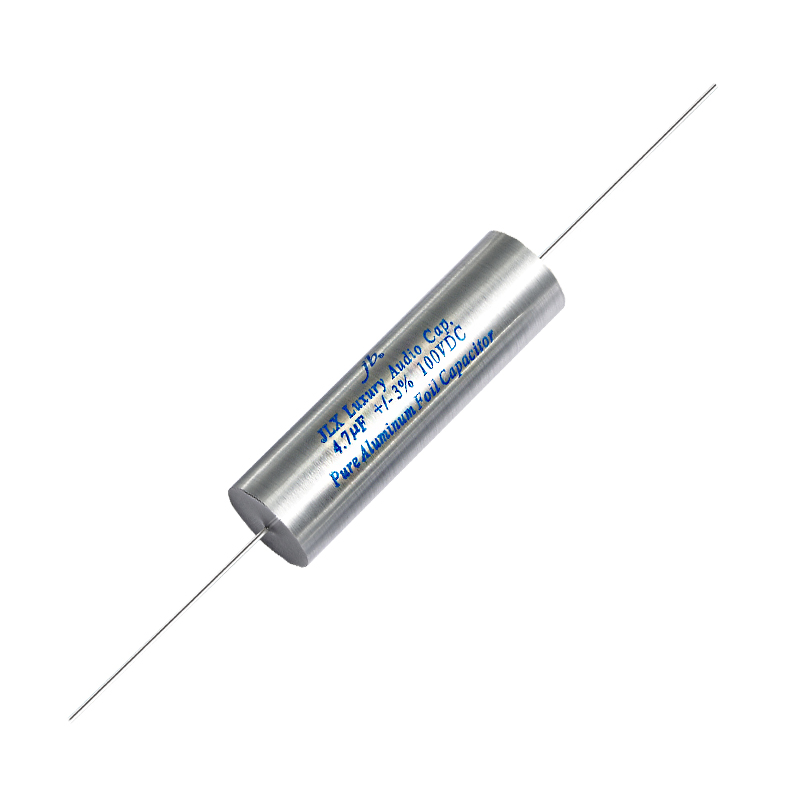
The JLX Luxury Aluminum Foil and Film Metallized Polypropylene Capacitors (Axial) are positioned as a high-end solution for modern tweeters and mid-range drivers. In many audio projects, JLX is evaluated as a Mundorf equivalent capacitor or a practical alternative to Jantzen Audio Alumen Z-cap, especially when balancing performance and sourcing considerations.
Why engineers consider JLX
- High precision capacitance tolerance: ±3% @ 1kHz
- Very low dielectric absorption factor
- Very low dissipation factor, very low ESR, very low inductance
- Available in 100V and 200VDC ratings
Third-party listening reviews indicate that JLX delivers a clear high-frequency presentation and balanced mid-range character. For reference, the published test review document is available below.
Why Engineers Inquire About JMX & JLX
When evaluating fast lead time capacitors for audio applications, engineers typically focus on:
- Electrical stability and specification transparency
- Suitability for crossover, tweeter, and signal path designs
- Reliable sourcing with consistent lead time
JMX and JLX are designed to support these requirements, allowing engineers to evaluate alternatives with confidence during design-in and RFQ stages.
RFQ Promotion (Limited Time)
During the promotion period, customers who submit an RFQ via the official website and include at least one JMX or JLX series part number or a clear specification requirement, after jb Capacitors verification, may receive a selected gift.
Notes
- RFQ content must be a real and specific project or design requirement, not a test, blank, or duplicate submission.
- Each company is eligible once during the promotion period.
- Gifts are limited and available while supplies last; jb Capacitors reserves the final right of review and interpretation.
Product Video
Enhancing Power Stability with Low ESR SMD Multilayer Solid Capacitors and Polymer Capacitors

Guest post • Technical insight • Updated:
Modern electronic systems continue to push the limits of power density, switching frequency, and board miniaturization. Maintaining stable rails, minimizing ripple and ensuring long-term reliability under electrical stress are now fundamental design goals. One of the most effective ways to reach these objectives is to select appropriate low ESR capacitors—in particular, polymer capacitors and SMD multilayer solid capacitors engineered for high-frequency, high-ripple environments.
Why Low ESR Capacitors Matter
Equivalent Series Resistance (ESR) directly affects a capacitor’s real-world behavior. Lower ESR delivers tangible benefits:
- Reduced ripple voltage at switching regulator outputs
- Lower internal heating and improved reliability
- Superior high-frequency filtering in noisy switching environments
- Faster transient response to sudden load changes
While traditional electrolytic capacitors struggle with higher ESR and limited ripple capability, polymer and multilayer solid capacitor technologies provide much better performance—especially when compact SMD footprints are required.
▶ polymer and multilayer solid capacitor technologies provide much better performance:
What Multilayer Solid Construction Brings to the Table
A multilayer solid capacitor typically stacks electrode layers with a solid conductive medium. This construction yields:
- Stable ESR across a broad frequency range
- Lower impedance on high-speed power rails
- High ripple current endurance
- Long operational life at elevated temperatures
These traits are particularly valuable for applications such as LED drivers, DC–DC converter stages, RF front-ends, industrial sensing equipment and compact communication electronics. By choosing SMD multilayer solid capacitors, designers can increase performance without expanding board area or component height.
Primary Applications That Benefit
1. High-Frequency DC–DC Converters
In switching regulators, low ESR helps smooth switching spikes, reduce output noise, improve converter efficiency and enhance transient response. Multilayer solid capacitors are commonly placed at both input and output nodes of buck, boost and point-of-load converters.
2. Communication & Networking Devices
Routers, IoT gateways and 5G modules house fast-switching processors and RF components that require low-impedance, stable rails. SMD multilayer solid capacitors deliver clean power in dense layouts while limiting self-heating and board-level thermal stress.
3. Industrial & Automation Electronics
Industrial controllers and PLC modules demand long operating life and steady performance. Solid capacitors resist high-frequency stress, maintain thermal stability and preserve electrical characteristics over extended operation—critical for equipment that runs continuously.
4. RF & High-Speed Digital Systems
RF circuits and high-speed digital boards depend on capacitors with predictable impedance. Polymer and multilayer solid capacitors provide low impedance across a wide frequency band, enabling cleaner power routing and less interference on sensitive signal lines.
Polymer vs. Multilayer Solid Capacitors: A Short Comparison
| Feature | Polymer Capacitors | Multilayer Solid Capacitors |
|---|---|---|
| ESR Performance | Very low | Low to ultra-low |
| Ripple Capability | High | High |
| Frequency Performance | Excellent | Excellent at high frequency |
| Size / SMD Options | Available (sometimes larger) | Compact, low-profile SMD |
| High-Temperature Lifetime | Strong | Strong (often superior in SMD variants) |
| Best Use Cases | CPU power, POL converters, high-current rails | RF, DC–DC filtering, compact consumer electronics |
How to Select the Right Low ESR Capacitor
Follow this practical checklist when choosing a capacitor technology for your design:
- Evaluate ripple current — higher ripple requires stronger thermal endurance and lower ESR.
- Determine operating frequency — ensure impedance remains low across the switching spectrum.
- Consider thermal limits — dense layouts benefit from capacitors with good heat dissipation.
- Optimize PCB space — SMD multilayer capacitors maximize performance with minimal footprint.
- Confirm lifetime requirements — target appropriate endurance ratings (e.g. 2,000–5,000 h @ 105°C for industrial use).
Looking Ahead: The Role of Low ESR Technologies in Compact Power Design
As power electronics advance toward faster switching and smaller form factors, demand for low ESR capacitor technologies— including polymer and multilayer solid solutions—will continue to grow. Improvements in conductive materials, dielectric stability and SMD packaging are making these components essential building blocks for next-generation electronics.
Engineers who prioritize low ESR, validated ripple ratings and strong thermal characteristics will be better positioned to design efficient, interference-resilient and long-lived systems—without compromising on size.
Why Low ESR and RoHS Solid-State Capacitors Are Essential for Next-Generation SMD Power Designs

As electronic systems move toward higher integration, smaller form factors and increased power density, traditional capacitor limitations become more visible. In modern SMD power designs, capacitor choice directly affects efficiency, thermal behavior and long-term field reliability.
Multilayer solid polymer capacitors such as the JEA and JEB series provide low ESR, stable capacitance and compact SMD packaging, making them well suited for DC–DC converters, processor rails and display power stages where every millimeter of PCB space and every degree of temperature margin matters.
▶ Inside a multilayer solid polymer capacitor structure:
The Role of ESR in Modern Power Circuits
Equivalent Series Resistance (ESR) is one of the key selection parameters for power capacitors. High ESR turns into:
- Additional I²R losses at switching frequency and ripple current
- Higher self-heating and hot spots around dense power stages
- Increased output ripple and poorer transient regulation under load steps
Low ESR solid polymer capacitors help engineers:
- Reduce output ripple on DC–DC converter rails
- Improve transient response for CPUs, ASICs and FPGAs
- Keep case and PCB temperatures under control in compact layouts
Why Solid-State Capacitors Replace Liquid Electrolytics
Compared with liquid electrolytic capacitors, solid polymer designs use a solid conductive polymer layer as the electrolyte. This structure:
- Eliminates evaporation and dry-out failure modes over time
- Maintains more stable capacitance and ESR over temperature
- Provides faster charge–discharge behavior under dynamic load conditions
- Offers better mechanical robustness against vibration and thermal cycling
For procurement teams, this translates into fewer field returns and more predictable product lifetime in applications with 24/7 operation or frequent temperature cycling.
JEA vs. JEB Multilayer Solid Polymer Capacitors
The JEA and JEB series share the same SMD footprint but target slightly different design windows. This allows engineers to keep one PCB pad layout while covering multiple voltage and capacitance requirements.
| Parameter | JEA Series | JEB Series |
|---|---|---|
| Rated voltage range | 2–16 Vdc | 2–25 Vdc |
| Capacitance range | 47–470 μF | 6.8–680 μF |
| Case size | 7.3 × 4.3 × 1.9 mm (low profile) | 7.3 × 4.3 × 2.8 mm |
| Endurance (105 °C) | 2,000 h under rated voltage | 2,000 h under rated voltage |
| Key benefit | Thin profile for height-limited designs | Extended voltage / capacitance window |
| Compliance | RoHS, Lead-free | |
Selection hints for engineers & buyers
- Use JEA when enclosure height or airflow clearance is tight, and operating voltage is ≤ 16 V.
- Use JEB when rails require up to 25 V or higher bulk capacitance in the same footprint.
- Check ripple current capability at 100 kHz against converter specifications, especially for high-load rails.
- For long-term supply planning, both series share common SMD footprint, simplifying second-source or alternate BOM strategies.
Design Considerations in SMD Power Stages
When integrating JEA / JEB into SMD power designs, engineers typically pay attention to:
- Voltage derating: keep some margin between rated voltage and maximum working voltage for better life and reliability.
- Ripple current vs. temperature rise: confirm that expected ripple current stays within rated limits at the target ambient and airflow conditions.
- Series / parallel combinations: use parallel capacitors to reduce ESR and distribute ripple, or combine with MLCCs to shape impedance across frequency.
- Layout: place caps close to power switches and load pins to minimize parasitic inductance and loop area.
For procurement and project managers, having a single family that can cover multiple rails (5 V, 12 V, 19–24 V, etc.) helps consolidate part numbers and simplify global sourcing.
Typical Applications
Low ESR, RoHS solid-state capacitors such as JEA and JEB are widely deployed in:
- Switching power supplies and DC–DC converters
- System boards and processor power rails
- Display cards, graphics and multimedia modules
- Small chargers, power adapters and USB PD designs
- Intelligent TVs and other consumer electronics
Go Further: Full jb Capacitor Catalogue
For projects that combine polymer capacitors with film, aluminum, tantalum or MLCC families, it is often useful to review all series in one place. The jb full catalogue provides:
- Side-by-side overview of capacitor technologies and series codes
- Voltage and capacitance ranges per family
- Recommended application segments for each series
You can download the complete catalogue for design reviews, internal documentation and sourcing comparison:
👉 jb Capacitors – Full Product Catalogue (PDF)
Compare voltage options, ESR performance and download datasheets or the full catalogue for your next SMD power design.