jb Summary of Capacitor Types
The table below gives and overview of the main characteristics of the various types of capacitor.
| Capacitor types | Capacitance range | Accuracy | Temperature stability | Leakage | Comments |
|---|---|---|---|---|---|
| Electrolytic | 0.1 µF - ~1 F | V poor | V poor | Poor | Polarised capacitor - widely used in power supplies for smoothing, and bypass where accuracy, etc is not required. |
| Ceramic | 10 pF - 1 µF | Variable | Variable | Average | Exact performanceof capacitor depends to a large extent on the ceramic used. |
| Tantalum | 0.1 µF - 500 µF | Poor | Poor | Poor | Polarised capacitor - very high capacitance density. |
| Silver mica | 1 pF - 3000 pF | Good | Good | Good | Rather expensive and large - not widely used these days except when small value accurate capacitors are needed. |
| Polyester (Mylar) | 0.001 µF - 50 µF | Good | Poor | Good | Inexpensive, and popular for non-demanding applications. |
| Polystyrene | 10 pF - 1 µF | V good | Good | V good | High quality, often used in filters and the like where accuracy is needed. |
| Polycarbonate | 100 pF - 20 µF | V good | V good | Good | Used in many high tolerance and hash environmental conditions. Supply now restricted. |
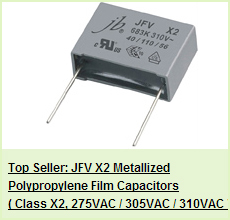
| Polypropylene | 100pF - 50 µF | V good | Good | V good | High performance and low dielectric absorption. |
| Teflon | 100 pF - 1 µF | V good | V v good | V v good | High performance - lowest dielectric absorption. |
| Glass | 10 pF - 1000 pF | Good | Good | V good | Excellent for very harsh environments while offering good stability. Very expensive. |
| Porcelain | 100 pF - 0.1 µF | Good | Good | Good | Good long term stability |
| Vacuum and air | 1 pF - 10 000 pF | Often used as variable capacitors in transmitters as a result of their very high voltage capability. |
Welcome to visit our jb capacitors website http://www.jbcapacitors.com/ to search your interestedcapacitors.